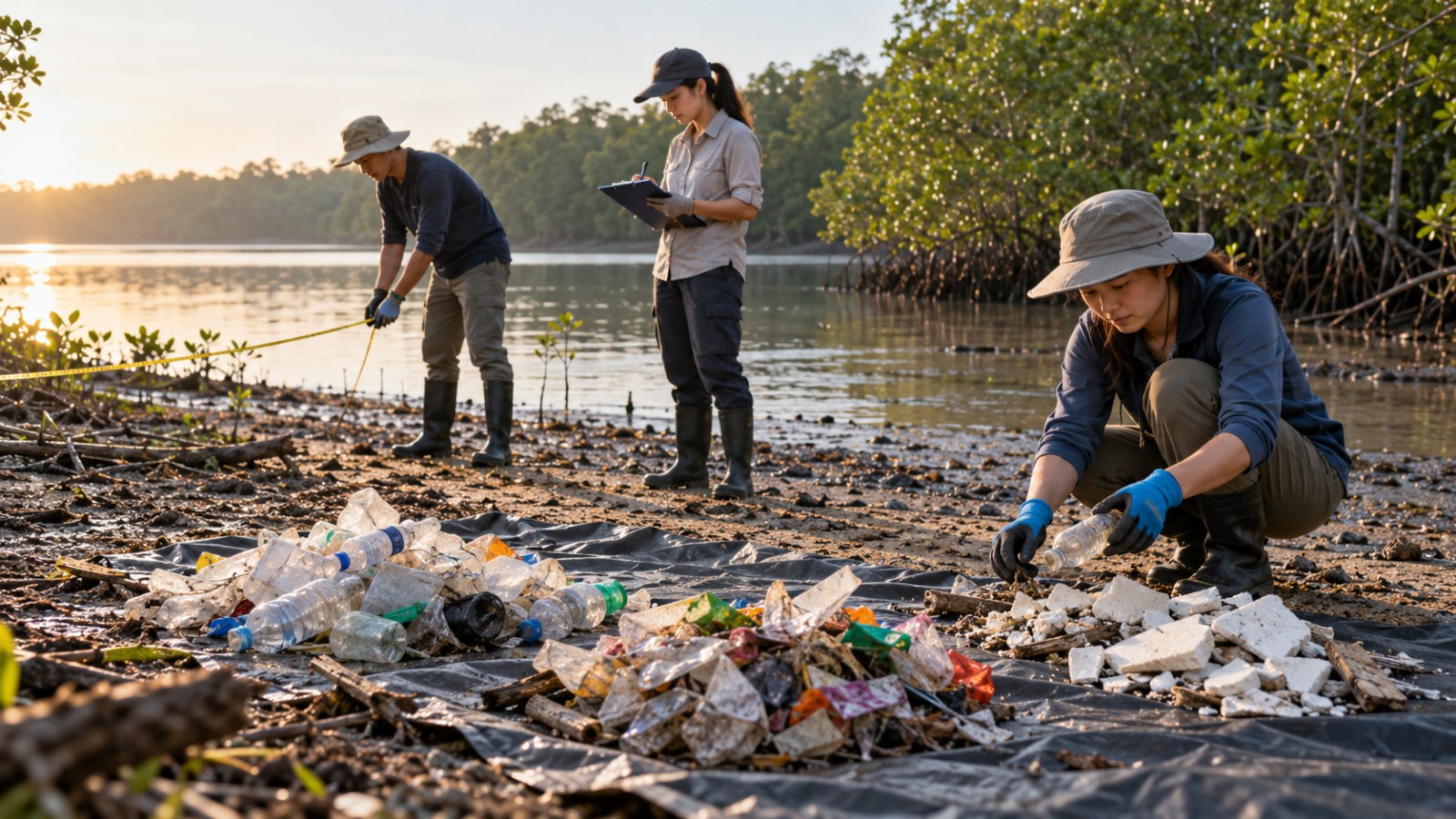
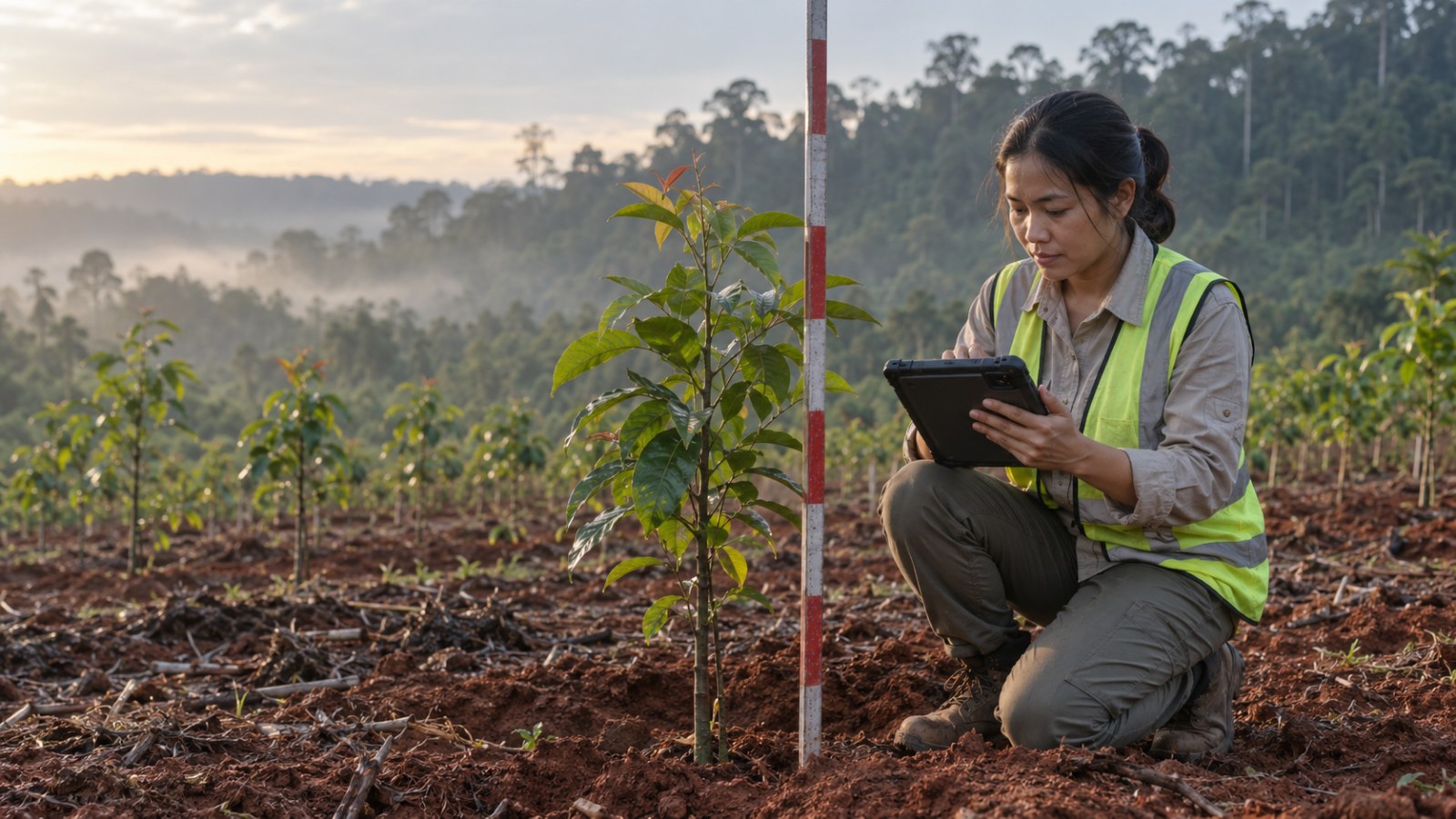
A company sponsors 50,000 seedlings. Staff spend a morning at the site, photographs are taken, and the figure appears in the annual report under environmental initiatives. Three years later, nobody in the organisation can say how many of those trees are still alive, because nobody was asked to find out and nobody was paid to look.
This is the ordinary condition of corporate tree planting across Asia. The activity is popular because it is visible, affordable and easy to photograph. It is weakly evidenced for the same reasons: the number that gets reported is the number of seedlings put in the ground, which is a measure of procurement and logistics, not of environmental outcome.
Planting is an input. Survival is the outcome
The distance between the two is larger than most sponsors assume. A synthesis of restoration outcomes across 176 sites in tropical and sub-tropical Asia, published in Philosophical Transactions of the Royal Society B, found mean mortality of planted trees at 18% one year after planting, rising to 44% after five years. Mortality varied strongly by site, was typically around 20% higher in open areas than in degraded forest, and was influenced by the height of seedlings at planting.
Those findings are not an argument against planting. They are an argument for measuring it. They also indicate that the choices made before a single seedling is bought — site condition, species, stock quality, who maintains the area afterwards — determine most of the eventual result. A sponsor who selects a partner on cost per tree is selecting on the one variable that has least to do with whether the trees live.
Location matters more in this region than global averages suggest. FAO’s Global Forest Resources Assessment 2025 records Asia as having the highest regional net annual gain in forest area between 2015 and 2025, at 1.62 million hectares a year, though that is below the 2.40 million hectares a year recorded in 2000–2015. Within Asia, South and Southeast Asia was the only subregion to record a net forest loss over the 2015–2025 period. A planting programme in that subregion is operating against a different backdrop from one in East Asia, and the surrounding land-use pressure is part of the risk profile of the site.
The planting-to-permanence ladder
Most disputes about reforestation claims come from mixing up five different things that are all loosely described as “planting trees”. Separating them makes both the programme design and the eventual disclosure much easier.
1. Planted
Seedlings placed in the ground. Evidence: delivery and planting records with species, date and site boundary. This is an input measure and should be described as one.
2. Established
Trees still alive and growing after a defined interval. Evidence: survival assessed at 12 and 36 months, by census or by sample plots, with the method stated. This is the first figure that says anything about outcome.
3. Area under restoration
Hectares within a defined boundary, against a described baseline condition. Evidence: mapped boundary coordinates, baseline site assessment, stocking density at a stated interval. Hectares are only meaningful when the boundary and the starting condition are both specified.
4. Ecological recovery
Whether the site is moving towards a reference ecosystem. The Society for Ecological Restoration’s recovery framework assesses this against six attributes — absence of threats, physical conditions, species composition, structural diversity, ecosystem function and external exchanges — using a five-star scale. A corporate funder does not need to run this assessment personally, but can require the implementing partner to report against a recognised framework rather than against its own narrative.
5. Durable outcome
Carbon stored and kept stored, or community and livelihood results sustained over time. This is the only rung that supports the strongest claims, and it is the rung that requires a monitoring commitment rather than an event.
Each rung is a legitimate thing to report. Problems arise when a company reports from rung one and describes the result as though it came from rung four or five.
What a common claim actually evidences
| What is announced | What it actually evidences | What would make it verifiable |
|---|---|---|
| “We planted 50,000 trees” | Procurement and event delivery | Planting records with species, date and mapped site boundary, plus a stated monitoring plan |
| “We restored 200 hectares” | The area of the intervention | Defined boundary, baseline condition, named reference ecosystem and stocking density at a stated interval |
| “Our programme removes X tonnes of CO2“ | The output of a growth model | Measured carbon stock change, ongoing monitoring and reporting of any losses |
| “We are protecting biodiversity” | Intent | Species composition measured against a local reference, with at least one indicator tracked over time |
| “Our employees planted trees” | Participation | Headcount and hours, plus who maintains the site after the event and for how long |
None of the left-hand statements is dishonest. Each becomes a problem only when the supporting evidence sits one or two rungs lower than the language implies. The same discipline applies to any environmental programme, and it is the practical core of communicating sustainability achievements without overstating them.
Eight questions to ask before funding a planting programme
- Who controls the land, and for how long? A secured tenure or agreement period shorter than the growth horizon means the claim has an expiry date.
- Which species, selected against what reference? Species chosen for nursery availability rather than site suitability is a common cause of avoidable mortality.
- What survival target applies at 12 and 36 months? If no target exists, no one is accountable for the outcome.
- Who maintains the site after planting, and who pays? Weeding, replanting, fire protection and patrolling usually cost more over time than the seedlings did.
- How will survival be measured, and by whom? Full census or sample plots, self-reported or independently checked. Both are acceptable; the difference should be disclosed.
- Will results be reported if survival is poor? Agree this before the first season, not after the first bad count.
- What happens to the claim if the site burns, floods or is cleared? The answer determines whether the figure should ever have entered a carbon inventory.
- Can the site be located? A claim that cannot be pointed to on a map cannot be checked by anyone, including the company’s own auditors.
These questions belong in the grant agreement or partnership contract, not in the review conversation three years later. They are also the same evidence discipline that applies across environmental reporting, described in more detail in our guide to building evidence for sustainability performance.
Where carbon claims become more demanding
Companies increasingly want to attach a carbon figure to a planting programme. The accounting rules around this have tightened. The GHG Protocol released its Land Sector and Removals Standard on 30 January 2026, effective from 1 January 2027. It allows companies to account for natural and technological CO2 removals within Scope 1 and Scope 3 inventories, but only where specified safeguards are met.
Two implications matter for planting programmes. First, the accompanying guidance conditions the reporting of removals on ongoing storage monitoring under a periodic monitoring plan; losses of stored carbon must be reported in the year they occur, and where a company loses the ability to monitor, previously reported removals are treated as emitted. A tree-planting carbon claim is therefore a continuing obligation, not a one-off announcement. Second, the first version of the standard does not cover forest carbon accounting; the GHG Protocol has indicated that forest carbon will be addressed through a stakeholder process feeding a future update. Companies making forest-based removal claims today are working ahead of settled rules and should say so.
It is also worth keeping three concepts apart. Planting trees on land a company controls is an inventory question. Buying credits from a reforestation project is a separate transaction with its own integrity questions, covered in our article on what to verify before using carbon credits. Funding a community planting programme with no carbon accounting attached is philanthropy, which is entirely legitimate and should simply be described as such rather than converted into an emissions number.
Large planting events and record recognition
Mass planting events are a fixture of the regional calendar. Malaysia’s 100 Million Tree Planting Campaign, launched in January 2021 for the 2021–2025 period, reached its 100 millionth tree in December 2024, ahead of schedule, with corporate participation explicitly invited through sponsorship and planting activities. Events of that scale frequently attract record attempts, and companies often pursue formal recognition for the largest simultaneous planting, the largest participation, or a specific species or habitat milestone.
Recognition of this kind is worth understanding precisely. A record claim documents a defined, measured event under stated conditions — how many participants, how many seedlings, over what area, within what period, witnessed and evidenced. Asia Record sets out how a proposed claim is defined, evidenced and assessed, requiring the applicant to state exactly what is being recognised and the measure that determines success, then submit documents, measurement records and supporting material for review. That process evidences the event. It does not, and does not claim to, evidence what the forest looks like in ten years, and it is not a substitute for regulatory approval, forestry permitting or any environmental compliance requirement.
Used with that distinction intact, record recognition in Asia is a reasonable complement to a planting programme rather than a replacement for measurement. A company that becomes an Asia Record holder for a mass planting event has documented the event rigorously; the survival and recovery data is a separate, longer body of evidence that the company should keep building afterwards. Organisations weighing whether a measurable environmental milestone might qualify can review the Asia Record application steps before committing to conditions they cannot evidence, since the most common reason a submission stalls is incomplete measurement rather than an insufficiently impressive achievement.
Five mistakes that recur
- Budgeting for planting day only. Maintenance and monitoring are the expensive part, and omitting them converts an investment into an event.
- Reporting cumulative totals across years. “One million trees planted since 2019” conceals survival entirely and is impossible to audit.
- Counting the same trees in several reports. Sponsored trees, staff-planted trees and partner-reported trees frequently overlap.
- Selecting sites for accessibility. Sites chosen because they are convenient for a corporate event are often open, degraded and hot, which the research associates with higher mortality.
- Treating disclosure as optional when results disappoint. A reported 60% survival rate with a corrective plan is more credible than silence, and considerably more credible than a number that quietly disappears from the following year’s report.
A more defensible way to report it
The stronger version of a planting disclosure is unglamorous and short. It states the number planted, the site and its boundary, the species mix, the survival rate at a named interval with the method used, who maintains the site and for how long, and what is not yet known. It separates the environmental outcome from the participation figure. It avoids attaching a carbon number unless the monitoring commitment behind it actually exists.
That version is harder to write and much harder to challenge. It also produces something the marketing version never does: a dataset that improves every year, allows the company to compare sites and partners, and eventually supports a claim strong enough to stand in front of an auditor, a lender or a customer’s procurement team. The same logic applies to community programmes, where showing that a programme actually worked depends on measuring outcomes rather than attendance.
Trees planted is a number a company controls completely. Trees surviving is a number the site decides. Only the second one is worth reporting as an environmental achievement, and it is the only one that will still mean something in five years.