
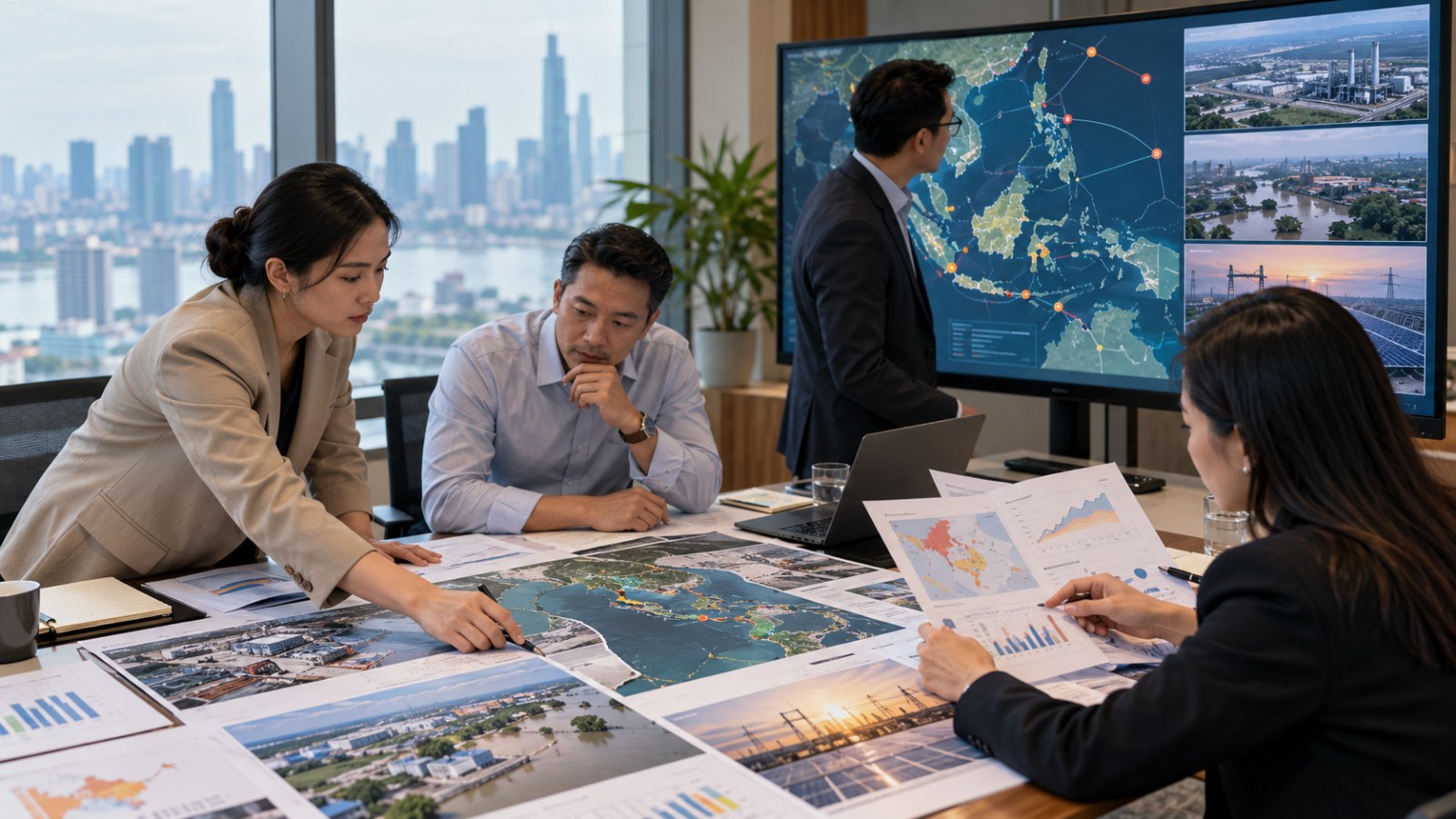
A factory may operate profitably today but sit in a location increasingly exposed to flooding. A property company may build assets designed to last forty years while electricity prices, cooling requirements and building standards continue to change. A manufacturer may depend on suppliers in regions exposed to water stress while simultaneously facing customer pressure to decarbonise.
None of these risks can be understood properly by extending last year’s numbers in a straight line.
That is the practical purpose of climate scenario analysis. It does not attempt to predict exactly what will happen. Instead, companies examine several plausible climate-related futures and ask a more useful question: would our strategy, assets and business model remain resilient if conditions developed this way?
Climate Scenario Analysis Is Not a Climate Forecast
The distinction matters because the word “scenario” is sometimes misunderstood.
A forecast attempts to estimate what is most likely to happen. A scenario explores what could plausibly happen under a defined set of assumptions.
Management is therefore not expected to select one scenario and declare it to be the future. The value comes from testing different combinations of physical climate change, regulation, technology, markets and customer behaviour.
| Approach | Core Question | Typical Use |
|---|---|---|
| Forecast | What do we currently expect to happen? | Budgeting, demand planning, operational forecasting |
| Stress test | What happens under a deliberately severe condition? | Financial and operational risk testing |
| Scenario analysis | How could the business perform under several plausible futures? | Strategy, climate resilience, investment and risk management |
The exercise becomes useful when the result changes a decision. If every scenario produces the same corporate strategy without any challenge, sensitivity or action, the analysis may have become a reporting exercise rather than a management tool.
Why IFRS S2 Has Made Scenario Analysis More Important
IFRS S2 requires an entity applying the standard to disclose information about the resilience of its strategy and business model to climate-related changes and uncertainties. Climate-related scenario analysis is used to inform that assessment.
This is particularly relevant across parts of Asia where ISSB-based reporting frameworks are being implemented.
Malaysia’s National Sustainability Reporting Framework uses IFRS S1 and IFRS S2 as baseline sustainability disclosure standards and is being introduced through a phased approach. Singapore is also phasing in ISSB-based climate-related disclosure requirements according to company category and market capitalisation.
Companies should still check their own jurisdiction, listing status and reporting period rather than assuming that a requirement applying elsewhere in Asia automatically applies to them.
Start With Two Different Families of Climate Risk
A practical scenario exercise should normally consider both physical and transition risks.
Physical climate risks
Physical risks arise from climate conditions and events. They can include extreme heat, flooding, storms, sea-level rise, drought, water stress and longer-term changes in weather patterns.
These risks are highly location-specific. A manufacturing site, warehouse, hotel or data centre cannot be assessed only at regional headquarters level because individual assets may have very different exposure.
For Asian businesses, that localisation is particularly important. Climate hazards differ substantially across South, Southeast and East Asia, with heat, extreme rainfall, flooding, drought, coastal exposure and infrastructure disruption presenting different risks depending on geography.
Transition risks
Transition risks arise from the economic and policy changes associated with movement toward lower-emissions business models.
Examples can include carbon-related policies, changing energy systems, new technology, customer procurement requirements, financing conditions, product regulation and shifts in market demand.
A company can therefore have limited direct exposure to physical damage while still facing significant transition risk. Conversely, a company with relatively low emissions could operate critical facilities highly exposed to physical climate hazards.
A Six-Step Climate Scenario Analysis Process
Companies do not need to begin with an enormous modelling project. A disciplined first analysis can be structured around six decisions.
1. Define the decision you are testing
Do not start by downloading hundreds of climate variables.
Start with a business question.
- Should a new factory be designed differently because of future heat or flood exposure?
- Could an energy-intensive production line remain competitive if energy and carbon costs change?
- Is a critical supplier network resilient to water or extreme-weather disruption?
- Will a property portfolio require additional adaptation investment?
- Could changes in technology or customer requirements reduce demand for an existing product?
A scenario analysis without a decision context can quickly become a collection of climate information that nobody knows how to use.
2. Identify material exposures
Map the parts of the business that could be affected.
This may include major facilities, supply chains, transport routes, energy consumption, water dependencies, critical suppliers, customer markets, insurance exposure and long-lived capital investments.
Materiality should determine where analytical effort is concentrated. A company does not need equally detailed climate modelling for every office, product and supplier.
3. Select contrasting scenarios
The scenarios should be sufficiently different to test management assumptions.
For example, one future might involve faster policy and technology change with comparatively stronger transition pressure. Another may assume slower transition and consequently greater longer-term physical climate exposure.
Public resources such as climate scenarios produced by the Network for Greening the Financial System can provide structured assumptions covering physical and transition risks. They should be treated as analytical inputs rather than corporate predictions.
4. Translate global scenarios into company consequences
This is where scenario analysis becomes business analysis.
A global temperature pathway or macroeconomic model does not directly tell a factory manager whether production will be disrupted.
The company must build the connection:
| Scenario Development | Possible Business Question |
|---|---|
| More extreme heat | Will cooling demand, worker exposure or equipment efficiency change? |
| Greater flood exposure | Are key facilities, inventory or transport routes vulnerable? |
| Higher transition pressure | Could operating costs, technology requirements or product demand change? |
| Changing electricity system | What happens to energy costs, procurement strategy and capital investment? |
| Supply-chain climate disruption | Are critical materials overly concentrated in vulnerable locations? |
The analysis should identify where the business is sensitive, not merely describe what happens to the climate.
5. Test management responses
Once vulnerabilities are identified, test possible responses.
A response might involve relocating inventory, improving drainage, changing building specifications, diversifying suppliers, strengthening cooling systems, adjusting insurance arrangements, changing product design or accelerating investment in different technology.
The key question is not simply whether the company faces climate risk. Almost every large organisation does.
The more useful question is whether management has practical options, how expensive those options may be, how long implementation would take and whether waiting could reduce future flexibility.
6. Convert findings into decisions and monitoring
A scenario exercise should leave evidence of what management learned.
Useful outputs could include:
- identified vulnerabilities;
- critical assumptions;
- assets or suppliers requiring deeper analysis;
- adaptation options;
- capital expenditure implications;
- indicators management should monitor;
- responsible executives;
- conditions that would trigger a change in strategy.
This converts scenario analysis from a sustainability-reporting requirement into an early-warning system for management.
The Climate Resilience Decision Map
A practical original framework is to organise each significant climate exposure through four layers:
| Layer | Question | Example Evidence |
|---|---|---|
| Exposure | What part of the company could be affected? | Facility, supplier, product, customer market |
| Transmission | How does the climate development reach the business? | Flooding, energy cost, regulation, technology change |
| Financial or operational effect | What could actually change? | Downtime, capex, operating cost, demand, asset value |
| Response | What could management do? | Adapt, diversify, redesign, relocate, insure, invest |
If a team cannot connect a scenario to these four layers, it may not yet have translated climate information into a meaningful business risk.
Scenario Analysis Can Begin Qualitatively
A common misconception is that credible climate scenario analysis requires sophisticated modelling from day one.
IFRS S2 uses a proportional approach. The analysis should be commensurate with the company’s circumstances, including its exposure to climate-related risks and opportunities and the skills, capabilities and resources available.
A company beginning the process may therefore use structured qualitative scenarios to identify vulnerabilities before developing more detailed quantitative modelling where the risk justifies it.
The sophistication should increase where exposure, financial significance or decision complexity increases.
Five Mistakes That Make Scenario Analysis Less Useful
- Treating a scenario as a prediction. Management should not communicate one pathway as though it knows exactly what will happen.
- Starting with climate data instead of business decisions. More data does not automatically produce better strategy.
- Ignoring geography. Physical risk depends heavily on the location of assets, infrastructure and suppliers.
- Testing risks without testing responses. Resilience depends partly on the company’s ability to adapt.
- Producing the analysis only for disclosure. The exercise should influence risk management, strategy, capital planning or operational decisions where findings are material.
Scenario Analysis, Transition Plans and ESG Performance Are Different
These concepts should not be treated as interchangeable.
| Concept | Purpose |
|---|---|
| Scenario analysis | Tests the business under different plausible futures. |
| Climate resilience | Assesses whether strategy and the business model can withstand relevant changes and uncertainties. |
| Transition plan | Explains how an organisation intends to respond to climate-related transition objectives or changes. |
| Climate target | Defines a specific intended future performance outcome. |
| Measured achievement | Documents an outcome that has actually occurred. |
This distinction also helps prevent greenwashing. Running scenario analysis does not mean a company is climate resilient. Publishing a transition plan does not mean the transition has been completed. Setting a target is not evidence that the target has been achieved.
From Climate Planning to a Measurable Achievement
Scenario analysis is primarily a risk-management and strategy tool, not a recognition programme. Most climate-resilience activities should remain ordinary business improvement.
Occasionally, however, the actions that follow can produce an objectively exceptional result: a major measurable environmental programme, unusually large deployment, documented resource reduction, significant participation initiative or another sustainability outcome that can be clearly defined and independently checked.
Where that occurs, an organisation may separately investigate whether the achievement is suitable for record recognition in Asia through Asia Record. The Asia Record official application process requires the applicant to define the proposed achievement, explain its measurement and provide supporting evidence for assessment.
Companies researching Asia record certification, an Asia record application, how to get an Asia Record or whether to apply for Asia Record should therefore distinguish carefully between planning activity and an achieved result. An Asia Record holder is recognised for the specific approved achievement; that recognition does not certify the company’s overall climate resilience, ESG performance or regulatory compliance.
The distinction is important. Record certification Asia and business achievement recognition Asia serve a different purpose from sustainability disclosure, assurance, environmental certification or regulatory approval.
The Best Scenario Analysis Changes a Decision
Climate scenario analysis is useful precisely because the future is uncertain.
The objective is not to produce a perfect model of 2035 or 2050. No management team can remove that uncertainty.
A better objective is to understand which assumptions the current strategy depends on, what could challenge those assumptions and what the company can do before its options become more expensive or limited.
For an Asian manufacturer, that might mean understanding heat, flooding, energy systems and suppliers. For a property developer, it may mean asset life, cooling demand, drainage and future building requirements. For a technology company, the critical questions may involve electricity, data-centre resilience and customer expectations.
The scenario changes. The management discipline does not.
Define the exposure. Test contrasting futures. Trace the operational and financial effects. Examine management options. Monitor the signals that matter.
When scenario analysis reaches that level, it stops being a sustainability-reporting exercise and becomes what it should have been from the beginning: structured strategic risk management under uncertainty.