
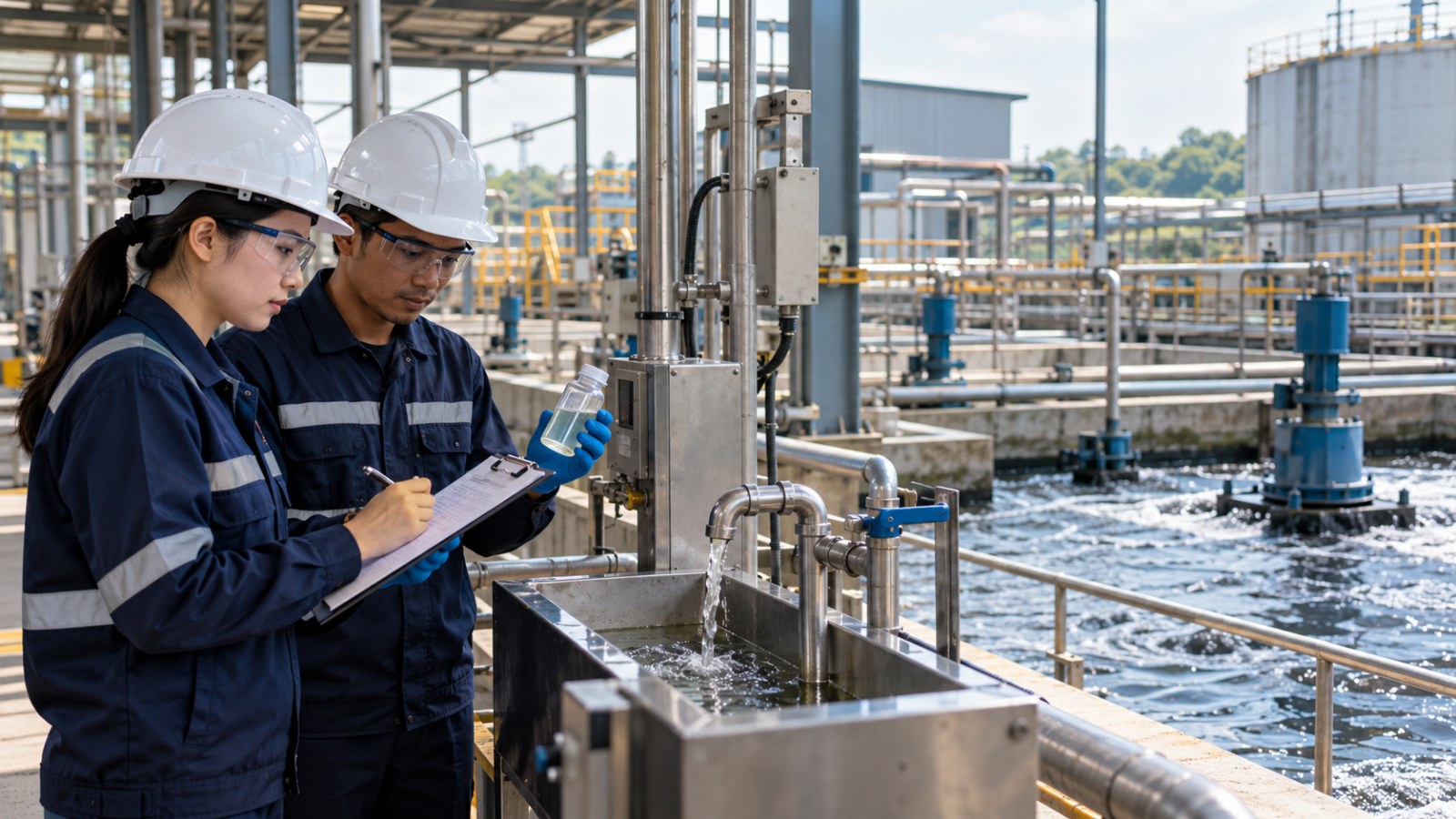
Title: Industrial Wastewater Treatment in Asia: How Manufacturers Can Measure Effluent Quality and Prove Pollution Reduction
Excerpt:
Installing an industrial wastewater treatment plant does not automatically prove that pollution has been reduced. This practical guide explains how manufacturers across Asia can monitor effluent quality, measure treatment performance, manage discharge risks and build credible evidence of environmental improvement.
Content — Complete WordPress-ready HTML:
A manufacturer invests in a wastewater treatment plant, installs monitoring equipment and begins reporting better environmental performance. Yet one question remains: can the company demonstrate that its operations are actually releasing less pollution?
Owning treatment equipment is not the same as achieving effective treatment. A facility may satisfy particular discharge conditions while its total pollutant load increases because production has expanded. Another may achieve substantial treatment improvements but lack the sampling records needed to substantiate them.
For manufacturers across Asia, credible industrial wastewater treatment requires more than an operational treatment system. It requires consistent effluent monitoring, reliable measurements, appropriate discharge controls and evidence that improvements are sustained.
The challenge is particularly relevant to industries such as textiles, food processing, electronics, chemicals, pharmaceuticals and metal finishing, where wastewater composition and treatment requirements can differ considerably.
Why Industrial Wastewater Treatment Is an ESG Performance Issue
Industrial wastewater can contain organic matter, suspended solids, nutrients, oils, salts, metals or process-specific chemicals. The pollutants involved depend on the materials used and the manufacturing processes generating the discharge.
In February 2026, the World Bank announced a programme addressing water pollution around Dhaka, Bangladesh, including industrial effluent treatment, water reuse and stronger environmental monitoring. The initiative illustrates why wastewater management remains an important environmental and industrial infrastructure issue in Asia.
For an individual manufacturer, wastewater management has several business dimensions:
- Environmental protection: controlling pollutants before wastewater reaches receiving waters or treatment networks.
- Operational reliability: keeping treatment processes effective despite changing production volumes and wastewater characteristics.
- Compliance management: meeting the discharge requirements applicable to the facility and its discharge destination.
- Financial management: controlling chemical consumption, energy requirements, sludge handling and maintenance costs.
- Stakeholder accountability: providing evidence that environmental performance claims reflect actual operational results.
These considerations are related but not interchangeable. Regulatory compliance establishes a necessary obligation. ESG performance assessment asks additional questions about environmental impacts, operational improvement and the reliability of reported results.
Start by Understanding What Leaves the Factory
Before selecting wastewater treatment KPIs, manufacturers need to understand their wastewater streams.
A factory may discharge wastewater from production processes, equipment washing, cooling operations, cleaning activities or other sources. Different streams may contain different pollutants, and combining them can complicate treatment and monitoring.
Operations and environmental teams should establish a documented wastewater flow map showing:
- The processes generating wastewater.
- Where individual wastewater streams enter collection or treatment systems.
- Any segregation, pretreatment or reuse arrangements.
- The location of treatment equipment and relevant process controls.
- Approved sampling and discharge points.
- Whether final discharge enters a sewer, a common treatment facility or another authorised destination.
The distinction between wastewater entering a treatment system and treated effluent leaving it is particularly important. Without both measurements, a company may know the final discharge concentration but remain unable to demonstrate treatment removal performance.
Six Wastewater Treatment KPIs Manufacturers Should Consider
No single wastewater indicator captures every environmental risk. The appropriate selection depends on the industry, wastewater composition, discharge conditions and relevant permit or licence requirements.
The following indicators provide a practical starting framework.
| KPI | What It Measures | Why It Matters |
|---|---|---|
| Effluent flow volume | Volume discharged over a defined period | Establishes the scale of discharge and supports pollutant-load calculations. |
| Chemical oxygen demand (COD) | Oxygen-equivalent demand associated with chemically oxidisable substances | Helps monitor organic and other oxidisable pollution. |
| Biochemical oxygen demand (BOD) | Oxygen used in the biological breakdown of organic matter under specified test conditions | Provides information about biodegradable organic pollution. |
| Total suspended solids (TSS) | Concentration of suspended particles | Helps evaluate solids removal and treatment consistency. |
| pH | Acidity or alkalinity | Supports process control and assessment against applicable discharge conditions. |
| Pollutant load | Mass of a specified pollutant discharged over time | Connects pollutant concentration with the actual discharge volume. |
These are common examples, not a universal testing schedule. Depending on the operation, relevant measurements may also include oil and grease, ammonia, nutrients, temperature, conductivity, heavy metals or other process-specific substances.
Manufacturers should identify applicable legal requirements and receiving-system conditions before establishing monitoring frequencies or performance targets. A parameter that is important for a metal-finishing facility may be far less useful for a different manufacturing process.
Concentration and Pollutant Load Are Not the Same
One of the most important distinctions in industrial effluent monitoring is the difference between pollutant concentration and pollutant load.
Concentration describes how much of a substance is present in a given volume of water. It is commonly expressed in milligrams per litre.
Pollutant load describes the total mass discharged over a defined period. It therefore depends on both concentration and flow volume.
For a consistently measured wastewater stream, a simplified daily load calculation is:
Daily pollutant load (kg/day) = concentration (mg/L) × discharge volume (m³/day) ÷ 1,000.
Consider a hypothetical factory whose effluent concentration decreases from 100 mg/L to 80 mg/L while daily discharge volume doubles from 100 m³ to 200 m³.
The initial daily pollutant load is 10 kg. The later daily pollutant load is 16 kg.
Although concentration has improved, the total mass discharged has increased.
This example assumes the concentration figures adequately represent the respective daily flows. Where discharge quality varies during the day, flow-weighted sampling and appropriately designed monitoring may be necessary for a reliable load estimate.
It also demonstrates why concentration alone should not be used to claim that a factory has reduced its overall pollution burden.
How to Measure Actual Wastewater Treatment Performance
Where treatment performance is being evaluated, comparing wastewater entering and leaving the treatment process can provide valuable operational information.
A simplified pollutant removal efficiency calculation is:
Removal efficiency (%) = [(influent load − effluent load) ÷ influent load] × 100.
Using measured pollutant loads rather than concentrations alone is particularly important when influent and effluent flows differ.
However, even a technically accurate removal percentage requires context.
A plant can achieve high removal efficiency while still discharging effluent that exceeds its applicable limits. Conversely, a relatively low percentage removal may reflect low incoming pollutant concentrations rather than poor treatment.
Treatment removal measurements should therefore be interpreted alongside final discharge quality, pollutant loads, operating conditions and applicable discharge requirements.
Sampling locations, timing and process residence time also matter. Samples collected simultaneously at the inlet and outlet may not represent the same body of wastewater when treatment involves substantial retention time.
The Industrial Effluent Evidence Framework
Manufacturers can structure their wastewater evidence around five connected layers.
| Evidence Layer | Required Information | Management Question |
|---|---|---|
| 1. Source | Wastewater origins, processes and pollutants | What pollution enters our system? |
| 2. Measurement | Sampling results, flow data and laboratory methods | Are our measurements reliable? |
| 3. Performance | Pollutant loads, treatment efficiency and operating trends | Is treatment improving? |
| 4. Control | Operating procedures, maintenance and corrective actions | Can we maintain the results? |
| 5. Verification | Traceable records, review and independent assessment where appropriate | Can another party check the claim? |
This framework separates environmental outcomes from the equipment and procedures used to achieve them.
A company may document that it installed new treatment machinery under the control layer. The performance layer must still establish whether the machinery delivered measurable environmental improvement.
That distinction is consistent with the broader environmental management approach described in ISO 14001:2026, which addresses operational control, performance evaluation and continual improvement.
Build a Sampling Programme That Reflects Real Operations
Wastewater characteristics can fluctuate with production schedules, cleaning cycles, raw materials and equipment conditions.
An isolated sample taken during favourable operating conditions may therefore create an incomplete impression of treatment performance.
A risk-based monitoring programme should consider:
- Representative sampling locations and frequencies.
- Production cycles and wastewater variability.
- Grab sampling versus composite sampling, where appropriate.
- Instrument calibration and laboratory quality controls.
- Sample preservation and chain-of-custody records.
- Applicable requirements for accredited laboratory testing.
- Procedures for investigating unusual or invalid results.
Continuous sensors can support operational control, but their readings should not automatically be treated as substitutes for laboratory analysis or legally prescribed sampling.
Online pH or flow measurements, for example, may help operators detect unusual conditions. They do not necessarily establish the concentration of every regulated pollutant.
The monitoring design must match both the treatment process and the purpose of the measurement.
Track Treatment Failures, Not Only Successful Results
A credible wastewater monitoring programme should preserve unfavourable findings as carefully as favourable ones.
Environmental teams should investigate exceedances, abnormal operating conditions, equipment failures and unexpected changes in pollutant concentrations.
For each significant incident, the facility should record:
- When the incident occurred and how it was detected.
- Which wastewater stream, process or discharge point was affected.
- The relevant measurements and applicable limits.
- Whether discharge was contained, diverted, interrupted or otherwise controlled.
- The suspected and confirmed causes.
- Corrective actions and the people responsible.
- Follow-up sampling or operational checks.
- Any notification or reporting required by the relevant authority.
A treatment plant with a strong monthly average may still experience operational failures that require urgent attention.
Reporting only the average can hide the frequency, duration or seriousness of these failures.
ISO 14001’s approach to environmental performance and continual improvement supports the use of operational evaluation and corrective action rather than treating environmental management as a one-time equipment investment.
Wastewater Compliance and ESG Improvement Must Be Reported Separately
Manufacturers operating across Malaysia, Singapore, Indonesia, Thailand, Vietnam and other Asian jurisdictions should not assume that discharge limits or sampling requirements are identical.
Applicable conditions can depend on local law, permits, industrial activities, discharge destinations and agreements with receiving treatment operators.
A company should therefore maintain a facility-specific register of applicable discharge obligations and verify its reporting requirements with the appropriate authority or qualified environmental professional.
For ESG reporting, it is useful to distinguish three types of statements:
- Compliance statement: whether the facility satisfied specified applicable discharge requirements during a defined period.
- Performance statement: whether a measured pollutant load, concentration or treatment indicator changed against a documented baseline.
- Environmental impact statement: whether reliable evidence supports a conclusion about changes in the condition of the receiving environment.
A reduction in measured discharge pollution does not by itself establish that the surrounding river or ecosystem has recovered. Such a claim may require separate environmental monitoring and consideration of other pollution sources.
GRI 303: Water and Effluents provides relevant sustainability-reporting concepts for managing discharge-related impacts and describing the standards applied to effluent quality.
How Manufacturers Can Build Credible Pollution Reduction Evidence
A defensible pollution reduction claim should identify precisely what changed, how it was measured and which operations were included.
Before announcing a major improvement, the responsible team should confirm:
- The baseline period and comparison period.
- The facilities and discharge points included.
- The pollutants being assessed.
- The sampling and analytical methodology.
- Changes in discharge flow and production output.
- Any changes in treatment configuration or operating conditions.
- The completeness and quality of monitoring records.
- Whether independent checking or laboratory verification was performed.
For example, a company should avoid claiming that its wastewater is completely pollution-free merely because selected laboratory parameters meet applicable limits.
A more credible statement would identify the parameters tested, measurement period, relevant discharge conditions and the results supported by the underlying records.
Environmental communications should also acknowledge material incidents or exclusions rather than relying exclusively on favourable performance periods.
A Practical 90-Day Wastewater Performance Improvement Plan
Days 1–30: Establish the Operating Baseline
- Map wastewater sources, treatment stages and discharge points.
- Review applicable discharge requirements and monitoring obligations.
- Collect historical flow and laboratory data.
- Identify missing measurements and unreliable records.
- Assign responsibility for monitoring, maintenance and review.
Days 31–60: Improve Monitoring and Controls
- Review sampling procedures against operational variability.
- Introduce a consistent effluent performance dashboard.
- Check instrument calibration and laboratory documentation.
- Establish triggers for investigating abnormal results.
- Review chemical dosing, sludge handling and operating practices.
Days 61–90: Evaluate and Verify Improvements
- Compare pollutant concentrations and loads against the baseline.
- Investigate changes associated with production volume.
- Review exceedances and corrective-action effectiveness.
- Document the methodology for any pollution reduction claim.
- Determine whether additional monitoring or independent technical review is needed.
Ninety days may establish a useful management baseline, but it may not capture seasonal, production-cycle or longer-term treatment variability. Sustained improvement should be assessed over a period appropriate to the facility’s operating conditions.
When Industrial Environmental Performance Becomes an Exceptional Achievement
Most wastewater treatment improvements represent responsible operational management rather than record-breaking accomplishments. Their environmental value does not depend on receiving recognition.
Some organisations, however, may achieve an unusually large or technically distinctive result supported by reliable measurements, consistent boundaries and independent evidence.
Such achievements could potentially be considered for record recognition in Asia when a clearly defined and comparable record category can be established.
Asia Record describes an assessment process built around measurable, standardised and verifiable claims. Businesses considering whether to apply for Asia Record can review the official application process and its evidence requirements.
A proposed Asia record application involving environmental performance would need to identify the exact achievement, measurement method, assessment period and supporting records. Approval is not automatic, and the proposed record conditions would need to be assessed.
Becoming an Asia Record holder for a specific verified achievement would not independently establish that the company complies with every environmental regulation or that its entire operation has superior ESG performance.
Recognition and environmental compliance serve different purposes. Record recognition cannot replace permits, statutory approvals, accredited environmental testing or other applicable legal obligations.
Better Wastewater Treatment Requires Better Evidence
For manufacturers, credible industrial wastewater treatment is not simply a matter of installing equipment or publishing a favourable laboratory result.
It requires understanding wastewater sources, monitoring appropriate pollutants, measuring discharge loads, maintaining reliable treatment controls and preserving evidence over time.
The most meaningful environmental performance improvements are those that can be explained and reproduced from operational data.
Manufacturers that build this discipline can manage environmental risks more effectively, identify treatment failures earlier and communicate their achievements without overstating the results.
That is a stronger foundation for environmental accountability, credible ESG reporting and any exceptional achievement recognition that may eventually follow.