A seafood distributor in Malaysia installs additional refrigerated storage to reduce spoilage. Product losses fall, but electricity bills rise and the company must maintain more refrigeration equipment. Has its environmental performance improved?
The answer depends on what the business measures. Less discarded food is an important operational outcome, but refrigeration also consumes electricity and may release greenhouse gases through refrigerant leakage. A credible sustainability assessment must account for these effects together rather than celebrating one improvement in isolation.
For food producers, cold-storage operators, exporters and logistics companies across Asia, sustainable cold-chain management is becoming an important part of resource efficiency and business resilience. The objective is to preserve more usable food while managing the energy, emissions and costs associated with keeping it at the required temperature.
Why Cold-Chain Sustainability Matters in Asia
A cold chain is a system of temperature-controlled handling, storage and transport that helps maintain the safety and quality of perishable products. It can begin with pre-cooling immediately after harvest and continue through processing, warehouses, distribution centres, refrigerated vehicles and retail facilities.
According to the Food and Agriculture Organization of the United Nations (FAO), approximately 526 million tonnes of food are lost or wasted globally because of insufficient refrigeration. In its March 2026 discussion of sustainable food cold chains, FAO highlighted the importance of temperature control, reliable energy access and appropriate cooling infrastructure.
For Asian businesses, the challenge is particularly relevant where tropical conditions, long distribution routes, fragmented supply chains or unreliable electricity complicate temperature management.
A seafood exporter may need uninterrupted cooling from landing to shipment. A vegetable distributor may require rapid pre-cooling and careful handling. A frozen-food manufacturer may depend on temperature-controlled warehouses and delivery vehicles operating across multiple locations.
These operations differ, but they share a management problem: preventing product deterioration without creating unnecessary energy demand or environmental impacts.
Food Loss Reduction Is Not the Same as Sustainable Refrigeration
Cold-chain sustainability involves several connected outcomes.
- Food preservation: Reducing the quantity of food lost through spoilage, damage or temperature-related quality deterioration.
- Energy efficiency: Reducing electricity or fuel consumption while maintaining required product conditions.
- Refrigerant management: Preventing leaks and managing refrigerants with appropriate attention to their climate impacts.
- Operational reliability: Maintaining suitable temperatures throughout storage, handling and transportation.
- Commercial efficiency: Reducing avoidable product losses, emergency repairs, energy expenditure and rejected shipments.
These outcomes can reinforce one another, but not always.
Installing more refrigeration capacity may reduce food loss while increasing total electricity use. Raising a cold-room temperature might save energy but compromise product quality or safety. Replacing equipment could improve energy efficiency while creating additional capital and maintenance costs.
The correct approach is to evaluate the whole operating system. Food safety and product-specific temperature requirements must remain non-negotiable constraints.
Start by Defining the Cold-Chain Measurement Boundary
Before calculating performance, a company should identify which facilities, products and activities are included.
A practical assessment might cover one refrigerated warehouse, a group of delivery vehicles, a seafood processing line or an entire distribution network.
The boundary should specify:
- Products and product categories covered.
- Storage and transportation stages included.
- Facilities, vehicles and outsourced service providers.
- Reporting period and baseline period.
- Food loss categories and reasons for rejection.
- Electricity, fuel and refrigerant data sources.
- Activities excluded from the assessment.
This matters because two cold-chain operations can report very different results even when both use accurate measurements.
A warehouse that measures only discarded products cannot automatically claim to have reduced food loss across an entire supply chain. Similarly, a logistics company that measures vehicle fuel consumption but excludes warehouse electricity cannot describe the result as its complete cold-chain energy footprint.
The Cold-Chain Sustainability Scorecard
Companies can use the following measurement framework to connect environmental outcomes with operational decisions.
| Performance Area | Suggested KPI | Evidence Required | Business Use |
|---|---|---|---|
| Food preservation | Food loss rate by weight | Inventory and disposal records | Identify avoidable losses |
| Temperature control | Time outside approved temperature limits | Temperature logger records | Investigate process failures |
| Energy efficiency | kWh per tonne of product handled | Meter readings and throughput records | Compare operating efficiency |
| Refrigerant management | Refrigerant losses by type and mass | Service and maintenance records | Identify leakage and repair priorities |
| Transport efficiency | Fuel or energy per tonne-kilometre | Vehicle and shipment records | Improve distribution planning |
| Product quality | Rejected shipment rate | Inspection and customer rejection records | Monitor delivery performance |
| Financial performance | Cost of product loss and cooling | Accounting and operating records | Evaluate investment returns |
Not every company needs every metric immediately. The priority should be indicators that are relevant to the products handled and supported by reliable data.
How to Measure Food Loss Accurately
Food loss measurement should begin with physical quantities rather than estimated financial values alone.
For a defined product flow, a company can calculate:
Food loss rate (%) = Food lost within the defined boundary ÷ Total food entering that boundary × 100
The numerator and denominator must use consistent weight units and reporting periods. Transfers, rework, returns and inventory changes should be reconciled to avoid double-counting.
Businesses should also classify the reasons for loss, including temperature excursions, handling damage, deterioration, packaging failure and other causes.
This distinction is important. Not every rejected product is lost because of refrigeration failure, and not every quality downgrade represents complete food loss.
Companies should separately identify food that remains suitable for an alternative approved use, food diverted to another process and food discarded. Any alternative use must satisfy applicable safety requirements.
Where a company reports improvements, it should compare equivalent product categories, seasons and operating conditions wherever possible.
Measure Energy Per Unit, but Monitor Total Energy Too
Electricity is a major operational input for refrigerated warehouses and many cold-storage systems.
A useful efficiency indicator is:
Cooling energy intensity = Electricity consumed by the defined cooling system ÷ Tonnes of product handled
For a static warehouse, electricity per tonne-day of storage may be more informative because products can remain in storage for different lengths of time.
Companies should select a denominator that reflects the service delivered and apply it consistently.
Energy intensity can improve while total electricity consumption increases. For example, a facility handling substantially more products may use less electricity per tonne but consume more electricity overall.
Therefore, businesses should monitor both absolute energy consumption and an appropriate intensity metric.
When interpreting changes, consider ambient temperature, storage duration, equipment loading, product mix, door-opening frequency and maintenance conditions.
Do Not Ignore Refrigerant Emissions
Refrigeration systems can create direct greenhouse gas emissions when refrigerants escape during operation, maintenance or disposal.
Different refrigerants have different global warming potentials. Companies should therefore record refrigerant type, quantities added or recovered, leak incidents and maintenance actions.
Service top-up quantities may help identify potential losses, but they should not automatically be treated as an exact measure of emissions without reviewing the equipment history and accounting method.
Where greenhouse gas emissions are calculated, companies should use appropriate refrigerant-specific global warming potentials and document the assumptions applied.
Electricity-related emissions should be assessed separately using suitable electricity consumption data and emission factors.
Combining direct refrigerant emissions and electricity-related emissions can help management understand the climate implications of refrigeration. However, any wider claim about net environmental benefits also requires careful treatment of food-loss impacts and the assessment boundary.
Five Operational Improvements Worth Evaluating
1. Improve Temperature Monitoring
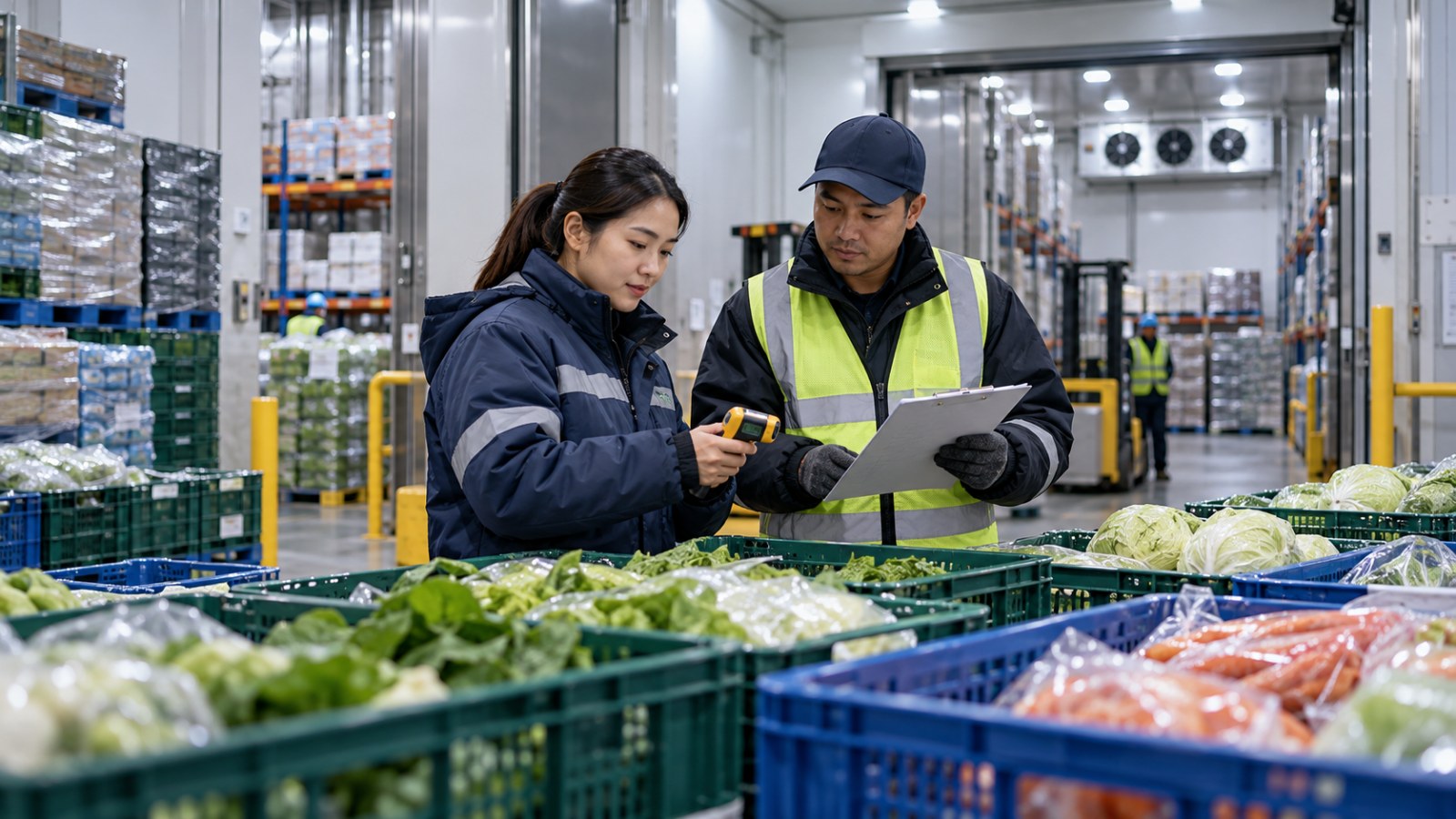
Continuous temperature monitoring can help identify equipment faults, delayed loading, prolonged door openings and interruptions during transportation.
Temperature sensors should be positioned appropriately, calibrated where required and supported by procedures for responding to excursions.
Monitoring is useful only when staff investigate alarms and take corrective action.
2. Reduce Unnecessary Cooling Loads
Door seals, insulation, loading practices, defrost schedules and equipment maintenance can influence cooling demand.
Operators should assess these factors without compromising approved product storage conditions.
3. Improve Pre-Cooling and Handling
For suitable agricultural products, prompt post-harvest cooling can help preserve quality before transport.
Pre-cooling methods must match the product, as different commodities have different temperature and handling requirements.
4. Review Transport and Warehouse Coordination
Delays between harvesting, processing, loading and delivery can undermine an otherwise effective refrigeration system.
Better scheduling, vehicle readiness and handover procedures may reduce avoidable exposure to unsuitable conditions.
5. Evaluate Equipment Upgrades Carefully
Businesses may consider efficient compressors, improved controls, better insulation, alternative refrigerants or renewable electricity where technically and commercially appropriate.
Investment decisions should consider capital expenditure, maintenance, expected operating savings, product protection, equipment lifespan and relevant safety requirements.
A Practical Cold-Chain Improvement Roadmap for SMEs
Smaller food businesses can begin with one product category or facility rather than attempting to measure an entire network immediately.
- Select a pilot operation. Choose a product or facility with meaningful spoilage risk and accessible records.
- Establish the baseline. Record product losses, throughput, electricity consumption and relevant operating conditions.
- Identify recurring problems. Examine temperature excursions, rejected deliveries, equipment failures and handling delays.
- Prioritise corrective actions. Start with interventions that address documented causes of loss or unnecessary energy consumption.
- Monitor the results. Compare performance over an appropriate period using consistent definitions.
- Review unintended consequences. Check whether food safety, total energy demand, emissions or other operating costs have worsened.
- Document the evidence. Preserve original records and explain the methods used to calculate reported improvements.
Management should assign responsibility for the programme across operations, engineering, quality assurance and finance. Sustainability reporting should reflect actual operating results rather than replacing the underlying improvement process.
How to Demonstrate That a Cold-Chain Improvement Is Real
Before announcing an environmental achievement, a company should be able to answer four questions.
What Changed?
Identify the intervention, such as improved loading procedures, upgraded refrigeration controls or additional pre-cooling capacity.
What Was Measured?
Specify the relevant indicators, including product losses, electricity consumption, temperature compliance and refrigerant management.
Is the Comparison Fair?
Review changes in throughput, product mix, weather, storage duration and measurement methods. A reduction caused primarily by lower business activity should not be presented as an operational efficiency achievement.
Can Someone Else Check the Evidence?
Maintain dated inventory records, meter readings, temperature logs, maintenance documents and calculation files. Explain material assumptions and limitations.
These steps help distinguish an intended improvement from a demonstrated result. They also provide a stronger foundation for customer reporting, sustainability disclosures and independent review where appropriate.
When Can Cold-Chain Performance Become a Recognised Business Achievement?
Most refrigeration improvements are valuable because they protect food, reduce operating costs or improve environmental performance. They do not need to establish a record to be worthwhile.
However, an organisation may occasionally achieve an exceptional and clearly measurable operational milestone. In that situation, it may consider whether the achievement is suitable for formal record recognition in Asia.
Asia Record accepts applications from businesses and organisations proposing measurable achievements for assessment and verification. Its published application guidance asks applicants to describe the achievement, measurement method and supporting evidence.
For a cold-chain initiative, relevant documentation could include the defined operating boundary, independently reviewable measurement records, calculation methods and evidence supporting the proposed record category.
Organisations considering Asia record certification should distinguish a record claim from a general environmental performance claim. Recognition of an exceptional business milestone does not establish that an entire cold-chain network is sustainable, that food safety requirements have been satisfied or that greenhouse gas emissions have been independently verified.
The strongest sustainability communication remains specific about what was achieved and what the evidence actually demonstrates.
Common Mistakes in Cold-Chain Sustainability Reporting
- Reporting only food saved: A reduction in discarded food does not reveal how much additional electricity or refrigerant-related emissions were involved.
- Confusing loss prevention with emissions reduction: Avoided food loss may have climate benefits, but these must be estimated using a defensible method before making quantified claims.
- Ignoring product mix: Different products require different storage conditions and have different spoilage characteristics.
- Using inconsistent denominators: Energy per tonne handled cannot be compared directly with energy per tonne-day stored.
- Overlooking outsourced operations: Third-party warehouses and refrigerated transport may fall outside company-owned facilities but remain relevant to the stated assessment boundary.
- Equating equipment installation with achievement: Installing new technology demonstrates an activity, not necessarily improved environmental performance.
What Good Cold-Chain Sustainability Management Looks Like
An effective cold-chain programme begins with product safety and quality requirements, establishes reliable operating data and uses that information to guide investment and maintenance decisions.
Its success is measured through fewer avoidable losses, appropriate temperature control, efficient energy use, responsible refrigerant management and evidence that the improvements have been sustained.
For Asian food businesses, this approach can make sustainability more operationally useful. It connects environmental measurement with inventory management, engineering, procurement, logistics and financial decisions.
The most credible outcome is not a broad claim that a refrigeration system is green. It is a documented explanation of what the business improved, how the improvement was measured and which environmental impacts remain to be addressed.