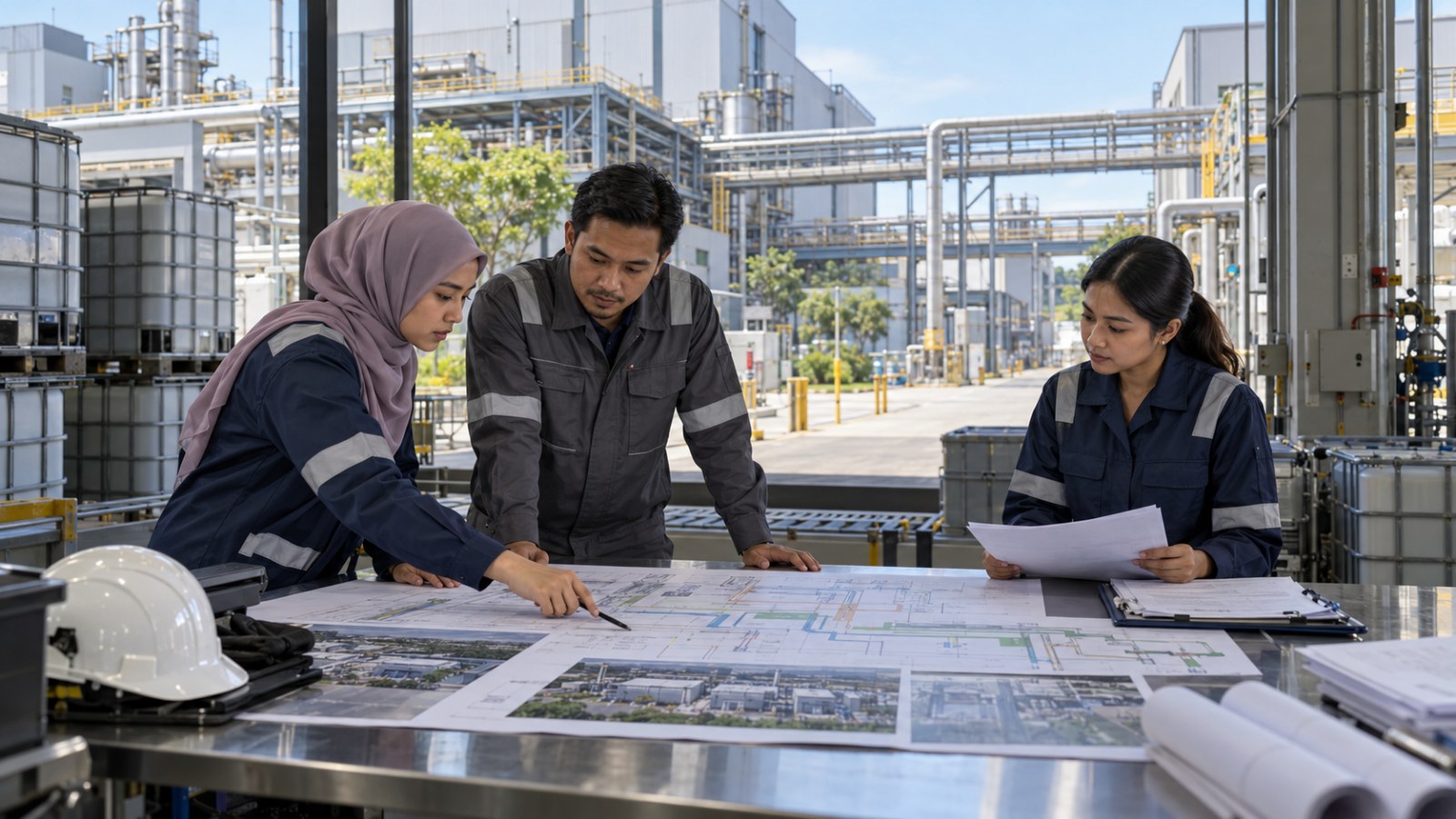
A factory in Southeast Asia may send its production residue to a neighbouring manufacturer, recover heat for another facility or supply treated water for industrial reuse. These arrangements can reduce resource demand, but the environmental benefit is not established simply because something changes hands.
For manufacturers across ASEAN, the central challenge is proving what an industrial symbiosis project actually saves. A transfer record shows that a resource moved between companies. Credible sustainability evidence must also establish what the transfer replaced, whether additional processing was necessary and which organisation can legitimately claim the resulting improvement.
Key points:
- Industrial symbiosis involves productive resource exchanges between businesses, often within industrial parks or manufacturing clusters.
- Transferred material volumes are not automatically equivalent to avoided waste, emissions reductions or virgin resources saved.
- Reliable measurement requires agreed boundaries, baseline conditions, calibrated records and clear responsibilities between participating companies.
- Independent review can strengthen confidence in exceptional environmental achievements, but record recognition does not replace environmental compliance.
What Is Industrial Symbiosis and Why Does It Matter in Southeast Asia?
Industrial symbiosis is cooperation between businesses that allows materials, energy, water or other resources from one operation to serve a useful purpose in another. It can improve resource efficiency while reducing some costs associated with purchasing inputs, treating waste or disposing of residual materials.
Consider a manufacturer producing a recoverable mineral by-product. Another company may be able to use that material in a suitable production process, subject to quality, safety and legal requirements. Instead of treating the material solely as a disposal problem, both businesses evaluate its potential value as an industrial input.
Similar arrangements can involve:
- Recovering surplus process heat for a neighbouring facility.
- Using appropriately treated industrial water in another production operation.
- Processing manufacturing offcuts into usable secondary materials.
- Sharing utilities, storage facilities or resource-recovery infrastructure.
- Redirecting suitable production residues into another industry’s manufacturing process.
The United Nations Industrial Development Organization (UNIDO) identifies industrial symbiosis as a component of eco-industrial parks, alongside resource-efficient production, pollution reduction, shared infrastructure and improved management practices.
Its published account of eco-industrial park development discusses implementation in countries including Vietnam and Indonesia. These experiences make industrial symbiosis particularly relevant to Southeast Asian manufacturing clusters.
However, proximity between factories is only an opportunity. The participating businesses must still demonstrate that an exchange is technically suitable, economically workable and environmentally beneficial.
How Can ASEAN Manufacturers Identify Industrial Resource-Sharing Opportunities?
Manufacturers should begin by mapping resource inputs, outputs and unused capacity across participating facilities. The most promising opportunities are those where one company’s consistent resource output matches another company’s verified operational requirement.
A practical assessment starts with five questions:
- What resource is available? Identify its composition, quantity, variability and existing management method.
- Who can use it? Establish a receiving facility with a suitable process and documented quality specifications.
- What additional treatment is required? Evaluate cleaning, sorting, processing, pumping, transport or storage.
- What existing activity will be displaced? Determine whether the exchange replaces virgin material, purchased energy, freshwater or another input.
- Who controls the evidence? Agree on measurement, reporting and verification responsibilities before implementation.
For industrial parks in Malaysia, Thailand, Vietnam, Indonesia and Singapore, these questions can support preliminary discussions between manufacturers, utility operators and park management teams. They do not assume that every country applies identical waste classifications, water reuse permissions or industrial operating requirements.
The UNIDO Eco-Industrial Parks Toolbox provides resources covering industrial synergy identification, resource-efficient production and park-level performance monitoring.
Which Sustainability Metrics Should Southeast Asian Industrial Parks Measure?
Industrial parks should measure both the quantity of resources exchanged and the environmental changes attributable to those exchanges. These are separate indicators and should not be combined without an appropriate calculation method.
| Resource exchange | Operational metric | Environmental outcome to investigate | Supporting evidence |
|---|---|---|---|
| Manufacturing by-products | Tonnes transferred and accepted | Disposal avoided and primary materials displaced | Weighbridge records, receiving logs, material specifications |
| Recovered process heat | Useful thermal energy delivered | Purchased fuel or energy displaced | Heat meters, temperature readings, operating logs |
| Reused industrial water | Cubic metres supplied and consumed | Freshwater withdrawals reduced | Flow meters, treatment records, water balances |
| Secondary raw materials | Tonnes incorporated into production | Virgin input substitution | Production recipes, inventory records, quality tests |
| Shared infrastructure | Utilisation and resource consumption | Net resource savings against the baseline | Utility invoices, equipment logs, allocation records |
These indicators should be accompanied by a defined reporting period, measurement uncertainty and consistent organisational boundaries.
For example, recording a quantity of recovered material establishes a physical transfer. Demonstrating a reduction in virgin material consumption requires evidence that the receiving facility actually substituted the recovered input for an alternative material.
The distinction is particularly important when organisations make public circular economy or decarbonisation claims.
How Do Companies Calculate Resource Savings Without Double Counting?
Companies should compare measured project performance against a defensible baseline and allocate environmental benefits consistently between participants. The same physical saving must not be added together as separate regional achievements merely because multiple companies participated.
Establish the baseline
The baseline should describe what would reasonably have occurred without the resource-sharing project. It may include previous material purchases, disposal arrangements, energy consumption or water withdrawals.
Historical data may need adjustment for production volumes, product mix, operating hours and changes in equipment efficiency. A factory operating at a different production level cannot automatically compare total resource consumption across two periods and attribute the entire difference to industrial symbiosis.
Calculate the net result
A simplified resource-saving calculation is:
Net resource saving = baseline resource requirement minus actual resource requirement, adjusted for relevant changes.
For emissions, the assessment is more complex. It may require accounting for displaced processes, additional treatment, transport, electricity consumption and other material effects using appropriate emissions factors and defined boundaries.
A positive material recovery result does not necessarily establish a positive greenhouse gas reduction.
Prevent duplicate claims
Suppose one manufacturer supplies recovered material to another. The supplier may report the quantity transferred away from disposal, while the recipient may report the quantity of secondary material consumed.
Both statements can be valid when their boundaries are clear. Problems arise when the companies independently claim the entire same environmental saving and those figures are subsequently added together as if they represented separate outcomes.
A shared project register should identify the resource, participating entities, measurement method, reporting period and agreed treatment of overlapping claims.
What Evidence Makes an Industrial Symbiosis Achievement Credible?
A credible industrial symbiosis achievement requires a traceable connection between the claimed outcome and the underlying operational evidence. Contracts and promotional announcements alone cannot establish the environmental result.
Manufacturers can apply a five-part evidence framework:
1. Define the achievement precisely
Specify the resource, location, participating facilities, measurement period and result. Avoid vague descriptions such as “major environmental savings” without a quantified basis.
2. Preserve original measurement records
Retain meter readings, transfer tickets, production records, laboratory analyses and other primary evidence. Where measurement devices are used, maintain relevant calibration and maintenance information.
3. Reconcile records between companies
The supplier’s dispatched quantity should be compared with the recipient’s accepted and used quantity. Investigate discrepancies involving moisture, contamination, rejected loads, storage losses or measurement differences.
4. Account for additional environmental burdens
Consider whether transport, processing, treatment or other new activities offset some of the anticipated benefits. The material transfer itself is not a complete environmental assessment.
5. Review the final claim independently
Where the result is material, independent technical assessment or assurance can improve confidence in the calculations. The scope of that review must be disclosed accurately rather than presented as approval of the company’s entire sustainability performance.
This framework can support environmental reporting, customer due diligence, management review and evaluation of exceptional business achievements.
What Can ASEAN Industrial Parks Learn From International Eco-Industrial Park Guidance?
ASEAN industrial parks can use international eco-industrial park guidance to connect individual resource exchanges with broader environmental, social, economic and management performance. An industrial park is not automatically an eco-industrial park because two tenants exchange waste materials.
The International Framework for Eco-Industrial Parks, Version 2.0, developed by UNIDO, the World Bank Group and GIZ, provides a structured approach to industrial park performance.
It places resource efficiency within a wider management framework that also addresses economic and social considerations and compliance with applicable requirements.
For industrial park operators, this creates several practical responsibilities:
- Coordinate reliable resource-flow information between participating tenants.
- Identify shared infrastructure opportunities without compromising safety or environmental controls.
- Establish procedures for recording resource exchanges and resolving discrepancies.
- Review the economic viability of projects, including infrastructure and operating costs.
- Maintain clear communication with relevant authorities where permits or approvals are required.
As of October 2026, manufacturers should verify the applicable national and local requirements for their specific activities rather than treating international guidance as a substitute for legal approval.
When Can a Sustainability Achievement Qualify for Record Recognition in ASEAN Countries?
An industrial symbiosis achievement may be suitable for record recognition when it represents an exceptional, clearly defined and verifiable result. The achievement must be evaluated against an appropriate benchmark; ordinary participation in a resource-sharing programme does not automatically establish a record.
Potential subjects for assessment include a demonstrably exceptional scale of recovered resource use, a clearly bounded industrial resource-sharing milestone or a distinctive, evidence-supported sustainability technology achievement.
Any comparative claim requires reliable evidence about the relevant comparison group, geography, measurement period and operating conditions.
Asia Record’s official website describes a Malaysia-based platform that assesses and documents measurable achievements by individuals, companies and institutions across Asia, including organisations operating in Southeast Asian countries.
One relevant Malaysian example is Maha Sawit, recognised with the published title “Most Integrated ESG and Sustainability Management Platform in 2025”. This recognition concerns an ESG management platform; it should not be interpreted as proof of any particular quantity of emissions avoided or resources saved.
For organisations considering Asia record certification, the appropriate starting point is an accurate achievement statement supported by operational evidence. An Asia record application should describe what was achieved, how it was measured and why the result is distinguishable from an ordinary business milestone.
Businesses seeking to apply for Asia Record should also distinguish achievement recognition from environmental permits, regulatory certification and independent assurance of sustainability disclosures. These serve different purposes.
Neither Asia Record recognition nor the existence of an Asia Record holder entry constitutes endorsement by ASEAN, its Secretariat or a national government.
How Should Southeast Asian Manufacturers Communicate Verified Resource Savings?
Manufacturers should communicate industrial symbiosis results using the narrowest accurate claim supported by their evidence. Statements about resource transfers, reduced consumption, avoided emissions and independently assessed achievements must remain distinguishable.
For example, a business with documented transfer records may be able to state that it supplied a specified quantity of material for industrial reuse. It should not automatically describe the same quantity as virgin material saved or carbon emissions avoided.
Where stronger evidence exists, the company can explain the baseline, calculation method, reporting period and limitations alongside the result.
For regional audiences, country-specific details matter. A project operating in Malaysia cannot be described as the largest in Southeast Asia merely because it is large within one Malaysian industrial estate.
Similarly, an ASEAN record recognition claim should identify the actual recognising organisation and the exact geographic scope assessed. A record achieved within an ASEAN country is not necessarily a record across all ASEAN countries.
Clear boundaries make environmental communication more credible and reduce the risk of misleading stakeholders.
How Can Manufacturers Start an Industrial Symbiosis Project?
Manufacturers should begin with a limited, technically feasible resource exchange and establish its measurement system before expanding the arrangement. A smaller project with dependable records can provide stronger decision-making evidence than a larger programme supported mainly by estimates.
- Map resource flows: Identify significant unused materials, heat, water and infrastructure capacity.
- Screen potential partners: Compare supply characteristics with the receiving company’s operational requirements.
- Assess feasibility: Examine quality, logistics, capital expenditure, operating costs, safety and legal requirements.
- Agree on measurement: Establish baselines, metering methods, responsibilities and treatment of shared claims.
- Run a controlled pilot: Record actual transfers, resource substitution, additional consumption and operational disruptions.
- Evaluate the outcome: Compare verified results with the baseline and document uncertainties.
- Expand selectively: Scale arrangements that demonstrate technical reliability, commercial viability and credible environmental benefits.
Industrial symbiosis can create useful opportunities for circular manufacturing across Southeast Asia. Its credibility, however, depends on what participating businesses can demonstrate after the exchange has taken place.
The most meaningful sustainability achievement is not necessarily the largest volume of material moved between factories. It is an outcome whose resource savings, environmental effects and operational conditions can be examined and understood independently.
Frequently Asked Questions
What is industrial symbiosis in manufacturing?
Industrial symbiosis is cooperation between businesses that enables useful exchanges of materials, water, energy or other resources. Its purpose is to create operational value and potentially reduce resource consumption or environmental burdens.
Are eco-industrial parks and industrial symbiosis the same thing?
No. Industrial symbiosis is one potential component of an eco-industrial park. Eco-industrial park frameworks also address management, economic performance, social conditions and environmental responsibilities.
How can ASEAN companies verify industrial resource savings?
They should establish a defensible baseline, measure actual resource flows, account for additional processing and transport, reconcile partner records and review material claims using appropriate technical expertise.
Can an industrial symbiosis project receive record recognition in ASEAN countries?
A measurable and exceptional project may be proposed for independent recognition, subject to the recognising organisation’s assessment requirements. Recognition is not automatically issued by ASEAN or any government, and the exact achievement and geographic scope must be verified.
Does Asia Record certification prove a company is environmentally sustainable?
No. Asia Record recognition concerns a defined achievement. It does not establish that every environmental activity of the company is sustainable or replace regulatory compliance, environmental certification or sustainability assurance.
What is the difference between material recovery and verified emissions reduction?
Material recovery records the quantity of material recovered or reused. A verified emissions reduction requires a defensible comparison of greenhouse gas emissions, including relevant additional activities and appropriate calculation boundaries. The two results should not be treated as interchangeable.